
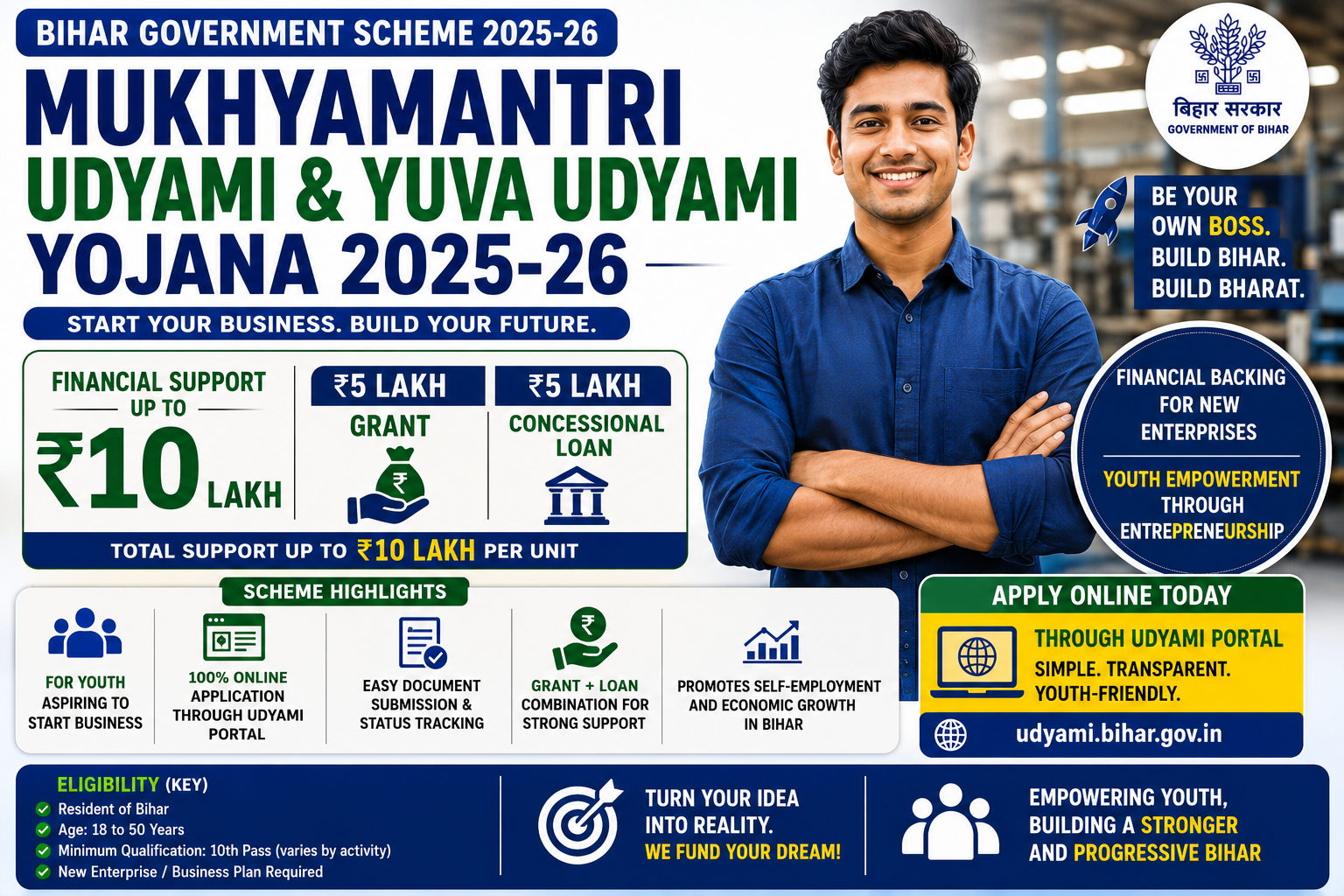
Bihar Mukhyamantri Udyami & Yuva Udyami Yojana 2025-26: Apply Online & Subsidy Guide
The Bihar Mukhyamantri Udyami and Mukhyamantri Yuva Udyami schemes are transformative initiatives designed to support young people who want to start their own businesses instead of running after traditional jobs. Implemented by the Department of Industries, Government of Bihar, these programs offer eligible youth up to ₹10 lakh in financial backing to set up a new enterprise, structurally divided into a ₹5 lakh grant and a ₹5 lakh highly concessional loan.
To ensure transparency and ease of access, the government has digitized the entire process through the dedicated Udyami portal, allowing applications, document submissions, and status tracking to be handled completely online.
Scheme Overview at a Glance
| Feature | Official Details |
|---|---|
| Implementing Authority | Department of Industries, Govt. of Bihar |
| Scheme Names | Mukhyamantri Udyami & Yuva Udyami Yojana |
| Maximum Financial Help | Up to ₹10,00,000 per project |
| Funding Structure | 50% Subsidy (₹5 Lakh) + 50% Loan (₹5 Lakh) |
| Interest Rates | 0% (Women, SC, ST) / 1% (General, OBC) |
Key Benefits & Financial Assistance Breakdown
In simple terms, the scheme provides financial help in a 50–50 format. Current updates for the 2025–26 cycle clearly state that a maximum of ₹10 lakh is available per unit. Here are the key points of assistance:
- Maximum Total Help: Up to ₹10,00,000 is sanctioned for one single project.
- The Subsidy Component: ₹5,00,000 is provided as a non-refundable subsidy (grant), which normally does not have to be returned provided you follow the scheme’s utilization conditions.
- The Loan Component: The remaining ₹5,00,000 is issued as a loan. For Women, SC, and ST beneficiaries, this loan is entirely interest‑free (0%). For General and OBC categories, the interest rate is highly subsidized at only 1% per year according to recent reports.
- Repayment Tenure: The loan portion is to be repaid over an extended period of about 7 years (84 easy installments), giving first-time business owners enough time for their enterprise to stabilize.
- Training and Support: Apart from capital, the scheme also includes mandatory entrepreneurship training and handholding support so that first‑time entrepreneurs can understand how to prepare a project report, maintain financial accounts, and handle statutory compliances.
Who Can Apply? Basic Eligibility Criteria
The state has deliberately kept the education and age criteria accessible so that serious and reasonably educated youth can utilize the scheme. The main eligibility conditions mentioned in recent notifications include:
- Domicile: The applicant must be a permanent resident of Bihar.
- Age Limit: The applicant’s age must fall between 18 and 50 years.
- Minimum Qualification: Intermediate (12th pass), or an ITI, or a Polytechnic diploma (or equivalent higher education).
- Employment Status: The applicant must not be a current government employee.
- Enterprise Status: The project has to be a brand-new business. Existing, currently running units are normally not covered for the same setup.
The scheme is open to a wide demographic: permanent resident youth, women, Scheduled Castes (SC), Scheduled Tribes (ST), Extremely Backward Classes (EBC), and general‑category youth. As noted, Women, SC, and ST applicants receive the most favorable terms due to the total interest waiver on their loan component.
What Kind of Business Can You Start?
The government has listed numerous model project types on the Udyami portal. Popular examples include oil mills, spice production, honey processing, poha/chura manufacturing, and various other small-scale manufacturing and service units.
While you are not strictly restricted to this exact list, your proposed project must fall under the small industry, processing, or service sectors where self‑employment and active job creation are clearly visible. The macroeconomic idea is that at least one person in each beneficiary family becomes self‑employed, while potentially providing jobs to one or two more local individuals, shifting the reliance away from government exams or out-of-state migration.
Mandatory Document Checklist
When you sit down to fill out the form on the Udyami portal, you will be required to upload several digital documents. Missing, incomplete, or unclear documents are the primary reason applications get stuck at the verification level. Ensure you have the following ready:
- Identity Proof: Aadhaar card.
- Residence Proof: A valid Residence or Domicile certificate of Bihar (often verifiable via the RTPS Bihar Portal).
- Educational Proof: Class 10 and 12 mark‑sheets and passing certificates, or your ITI/Polytechnic certificates.
- Category Proof: Caste certificate for SC, ST, EBC, or BC categories if you are claiming those specific interest benefits.
- Bank Details: A bank passbook or a cancelled cheque to facilitate the eventual fund transfer.
- Business Plan: A simple project report or business plan detailing your proposed unit.
- Visuals: A recent passport‑size photograph and a clear scanned signature.
- Note: For some applicants, an income certificate and ration card details may also be requested at the scrutiny stage.
Step-by-Step Online Application Process
The application process runs strictly through the dedicated Udyami portal. While exact deadline dates change annually, the broad procedural steps remain identical:
1. Portal Visit and Registration
Go to the official Udyami Bihar Portal where separate application pathways exist for Mukhyamantri Udyami, Mahila Udyami, and Yuva Udyami. Click on registration and enter your name, mobile number, and Aadhaar number. You will receive an OTP on your mobile; after entering it, your registration is finalized and the main form opens.
2. Filling the Application Form
Provide your personal information including your name, father’s/husband’s name, full address, category, age, and educational details. Next, detail your proposed business: type of unit, location (district and block), estimated project cost, your own capital contribution, and how many people you expect to employ.
3. Uploading Documents
Upload clear, scanned copies of your Aadhaar, residence certificate, caste certificate, educational certificates, bank passbook, photograph, and project report. All files must strictly adhere to the allowed format and size parameters.
4. Scrutiny and Selection List
After the application window closes, the department scrutinizes the applications and prepares a merit selection list. As per recent 2026 updates, this list is expected to appear on the portal within about 10 days after scrutiny concludes. Applicants can log in to check their status.
5. Training and Final Approval
Those whose names appear on the selection list are called for a mandatory training program at the district or headquarters level, typically lasting about 6 days. During this training, your original documents and business plan are cross-checked, and you are taught the fundamentals of entrepreneurship and financial management.
6. Sanction and Disbursement of Money
After successful completion of training and final verification, the loan and subsidy are officially sanctioned. Up to ₹10 lakh is released, with half (₹5 lakh) treated as a non‑refundable grant and the other half (₹5 lakh) as a loan. The loan is repayable over 7 years in 84 easy installments.
The Evolution: SC/ST Udyami Yojana Origins
Before this broader Udyami/Yuva Udyami structure was established, Bihar operated the specifically focused SC/ST Bihar Udyami Yojana. That earlier scheme provided an interest‑free loan up to ₹5 lakh and covered up to 50 percent of the project cost as support, alongside ₹25,000 specifically allocated for training and monitoring. Eligibility required Bihar citizenship, SC/ST category status, age above 18 years, and an Intermediate or ITI/Polytechnic qualification.
The current Mukhyamantri Udyami and Yuva Udyami schemes essentially scale this successful template up to a ₹10 lakh limit and aggressively expand it to include women, EBC, BC, and general youth demographics. While interest rules vary slightly by category, the core philosophy remains untouched: half the capital as a grant, and half as a very soft loan.
Policy Intent: Why This Scheme Matters for Bihar Youth
For a first‑time entrepreneur lacking traditional collateral, arranging ₹8–10 lakh from commercial markets is extremely difficult. This scheme bridges that gap by putting direct government risk capital on the table—₹5 lakh as a grant, ₹5 lakh as a near‑free loan—and heavily backing it with institutional training.
In a state where a massive portion of the youth demographic spends years preparing for government competitive exams or migrates to other states for low‑paid work, such schemes construct a vital parallel path. By fostering local businesses in manufacturing, services, and agro‑processing, the state aims to generate sustainable income inside Bihar itself. With transparent and timely implementation, the Mukhyamantri Udyami and Yuva Udyami Yojana are poised to gradually build a robust, resilient base of small entrepreneurs across all districts.
Frequently Asked Questions (FAQs)
Q1. What is the maximum financial assistance provided under the Mukhyamantri Yuva Udyami Yojana?
Eligible youth can receive up to ₹10,00,000 to start a new business. This amount is divided into a 50% non-refundable subsidy (up to ₹5 lakh) and a 50% highly concessional loan (up to ₹5 lakh).
Q2. What is the interest rate applied to the loan component?
The interest rate depends on your category. For Women, Scheduled Castes (SC), and Scheduled Tribes (ST), the loan is 100% interest-free (0%). For General and OBC categories, a nominal interest rate of 1% per annum is applied.
Q3. What is the minimum educational qualification required to apply?
Applicants must have passed at least their Intermediate (12th Standard) exams. Alternatively, holding an ITI certificate, a Polytechnic diploma, or an equivalent higher educational degree also satisfies the minimum criteria.
Q4. Can I use this scheme to expand a business I already own?
No. The Mukhyamantri Udyami and Yuva Udyami schemes are strictly designed to fund the establishment of brand-new enterprises. Existing or currently running business units are not eligible for funding under this framework.