
Bihar Alpsankhyak Muslim Talaqshuda Mahila Sahayata Yojana 2026: ₹25,000 Grant & Apply Guide
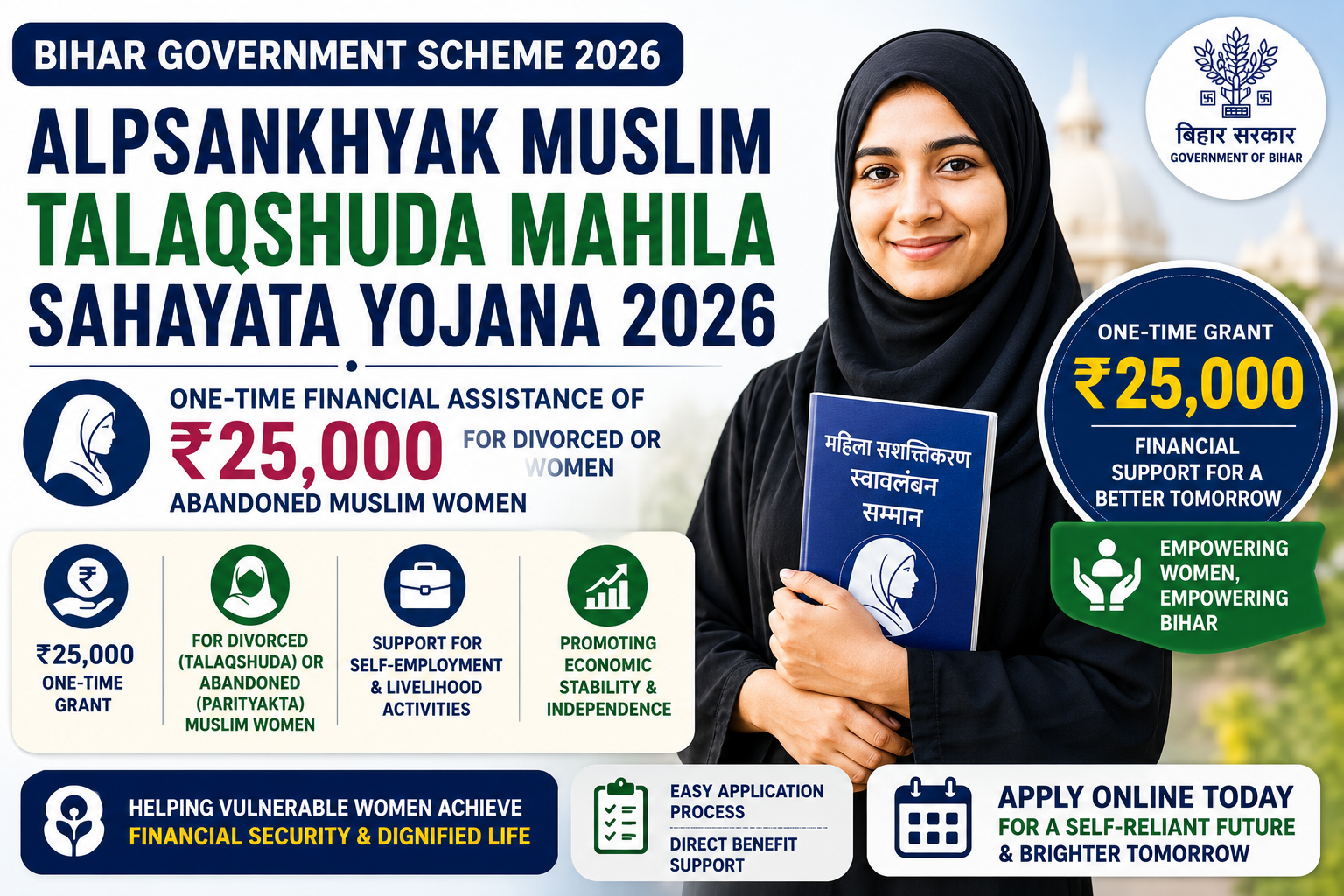
The Alpsankhyak Muslim Parityaqta/Talaqshuda Mahila Sahayata Yojana is a highly targeted state welfare scheme administered by the Minority Welfare Department, Government of Bihar. The initiative provides a one‑time financial assistance of ₹25,000 to minority Muslim women who are abandoned (parityakta) or divorced (talaaqshudaa).
The primary aim of this policy is to help vulnerable women achieve basic economic stability and launch small self‑employment activities immediately after separation, preventing them from remaining completely dependent on relatives or informal support networks.
Scheme Overview at a Glance
| Feature | Official Details |
|---|---|
| Implementing Authority | Minority Welfare Department, Govt. of Bihar |
| Scheme Name | Alpsankhyak Muslim Mahila Parityaqta/Talaqshuda Sahayata Yojana |
| Financial Assistance | ₹25,000 (One-time lump-sum grant) |
| Target Beneficiaries | Abandoned or Divorced Minority Muslim Women in Bihar |
| Official Application Portal | e-Kalyan Bihar Portal |
Key Benefits & Financial Assistance
Unlike standard social security programs, this scheme provides a lump‑sum capital grant rather than a recurring monthly pension. This structure is specifically designed to function as seed money for economic independence.
- One‑Time Financial Assistance: The Bihar government provides a flat ₹25,000 as a one‑time grant to eligible minority Muslim divorced or abandoned women. (Note: Historically, this assistance was ₹10,000, but from FY 2017‑18, it was increased by 150% to ₹25,000 to better reflect the real costs of starting livelihood activities).
- Purpose of the Grant: The capital is strictly meant to help women start small self‑employment or livelihood micro-activities (such as setting up a petty shop, tailoring, livestock rearing, etc.) and to manage essential household needs immediately post-divorce or abandonment.
- Mode of Payment: The entire ₹25,000 amount is transferred seamlessly and securely directly into the beneficiary’s bank account via Direct Benefit Transfer (DBT), administered through the Minority Welfare Department’s e‑Kalyan system.
Who Can Apply? Eligibility Criteria
The scheme is tightly targeted at a highly specific and vulnerable demographic. To qualify, applicants must meet the following strict conditions:
- Religion and Minority Status: The applicant must be a Muslim woman officially belonging to the recognized minority community within Bihar.
- Marital Status: The applicant must legally be parityaqta (abandoned) or talaaqshudaa (divorced). The official scheme guidelines and application forms specifically reference “अल्पसंख्यक मुस्लिम परित्यक्ता/तलाकशुदा महिलाओं हेतु सहायता योजना”.
- Residence / Domicile: The applicant must be a permanent resident of Bihar, which is typically proven by submitting a valid state residence or domicile certificate.
- Income Condition: The applicant must belong to an economically weaker section. The annual family income must fall strictly within the modest limits prescribed for state minority welfare schemes (exact figures fluctuate and should be checked against the latest yearly notification).
- Non‑Duplication Condition: The applicant must not be receiving overlapping financial assistance from other state or central government schemes for the exact same purpose.
- Age Requirements: While public descriptions focus on marital and economic status, applicants must legally be adult women (18+ years).
Mandatory Document Checklist
Applicants must submit a complete, legally verifiable set of documents proving their identity, minority status, marital status, and economic condition. Missing or unverified documents are the primary reason for application delays.
- Identity Proof: Aadhaar card or Voter ID of the applicant.
- Residence/Domicile Proof: A valid Residence certificate, ration card, or Voter ID definitively showing the applicant is a local resident of Bihar.
- Proof of Marital Status: A formal divorce certificate, talaaqnama, or court order confirming that the applicant is divorced (talaaqshudaa). For abandoned women (parityaqta), appropriate documentation or a legally binding affidavit as defined by scheme rules—often supported by local ward/panchayat authority certification—is required.
- Minority Status: While identity documents and community details normally establish this, a formal minority certificate may sometimes be requested by local offices.
- Income Certificate: A recent Income Certificate issued by a competent authority via the RTPS Bihar Portal showing that the family income is within the scheme’s specified threshold.
- Bank Account Details: A bank passbook or cancelled cheque in the applicant’s name to facilitate the DBT of the ₹25,000 grant.
- Photographs & Forms: Recent passport‑size photographs to be affixed on the duly filled official application format (“मुस्लिम परित्यक्ता/तलाकशुदा महिलाओं हेतु सहायता योजना – आवेदन पत्र”).
Note: All documents must be self‑attested and, where required, verified by local authorities before being forwarded to district‑level minority welfare offices.
Step‑by‑Step Application Process
The scheme is administered through a hybrid model: online registration via the state’s e‑Kalyan portal combined with rigorous physical verification at the district level.
- Visit the Official Portal: Navigate to the e‑Kalyan / Minority Welfare portal of Bihar, where the “Alpsankhyak Muslim Mahila Parityaqta/Talaqshuda hetu Sahayata Yojana” is officially listed.
- Register as a New User: Register on the portal using your name, mobile number, email, and Aadhaar details. Securely verify your account via OTP.
- Fill the Online Application Form: Select the relevant scheme from the dashboard. Provide your personal information, address, religion (Muslim), category, and contact details. Enter your exact marital status (parityaqta or talaaqshudaa) and provide brief details of the separation/divorce as requested.
- Upload Required Documents: Upload high-quality scanned copies of your identity proof, domicile, divorce/talaaq documents, income certificate, and bank details. Ensure file sizes meet the portal’s technical requirements.
- Submit & Save Reference Number: Review all entries carefully and submit the form. Immediately print or note down the application reference number for future status tracking.
- Block and District-Level Verification: Applications are first scrutinized at the block level by the Block Development Office or Minority Welfare field staff, who verify the documents against ground realities. The files are then forwarded to the District Minority Welfare Office for final scrutiny.
- Sanction and Approval: Eligible applications are sanctioned by the District Minority Welfare Officer or an assigned committee, confirming all criteria (Muslim, divorced/abandoned, income limit, no overlapping aid) have been met.
- DBT Disbursement: Upon final approval, the state government initiates a Direct Benefit Transfer of ₹25,000 straight into the applicant’s bank account.
Post-Disbursement Follow-Up: Beneficiaries are highly encouraged to use the funds for self‑employment rather than consumptive purposes. In certain districts, field staff conduct follow-ups to assess how the capital assistance has impacted the beneficiary’s economic condition. If the portal mandates offline submission, the applicant must print the filled form and submit it physically with documents at the Block or District Minority Welfare Office.
The Policy Intent
The Alpsankhyak Muslim Parityaqta/Talaqshuda Mahila Sahayata Yojana addresses a critically vulnerable demographic: minority Muslim women who have been abandoned or divorced, many of whom are left without secure income, social security, or strong natal family financial support.
By providing a lump‑sum grant of ₹25,000, the Bihar government aims to inject a vital capital cushion, allowing these women to create their own immediate livelihood, pay for necessary vocational training, or simply stabilize their household in the highly turbulent post‑divorce phase.
From a macroeconomic policy perspective, this scheme fits seamlessly into the state’s broader minority welfare and women’s empowerment agenda. It recognizes that personal laws and prevailing social norms often leave divorced Muslim women with minimal to no alimony or maintenance, and actively attempts to partially correct this deep structural vulnerability through targeted, direct state financial intervention.
Frequently Asked Questions (FAQs)
Q1. Is the ₹25,000 assistance a monthly pension or a one‑time grant?
It is strictly a one‑time financial capital grant of ₹25,000, not a recurring monthly pension. The amount was historically ₹10,000 but was increased by the state government to ₹25,000 to better support the actual costs of starting self‑employment and achieving basic sustenance.
Q2. Who exactly is eligible under this scheme?
Eligibility is restricted to minority Muslim women who are legally abandoned (parityaqta) or divorced (talaaqshudaa) and are permanent residents of Bihar. They must belong to economically weaker families and cannot be receiving similar capital assistance from overlapping government schemes.
Q3. How do I apply for the divorced Muslim women financial aid in Bihar?
You must register and apply online through the Bihar e‑Kalyan/Minority Welfare portal. After filling out the specific Sahayata form, you must upload your identity, domicile, divorce/talaaq proof, income certificate, and bank details. Following online submission, applications undergo physical verification at the block and district levels.
Q4. How is the money paid and can I track my application?
After your application is fully verified and officially sanctioned by the District Minority Welfare Office, the ₹25,000 is paid directly into your verified bank account via Direct Benefit Transfer (DBT). You can track your processing status using your unique application reference number on the e‑Kalyan portal, or by contacting your local district Minority Welfare Office.